
Reviewed · HISTORICAL TOURS
Galway History Walking tour with Local expert – Private Group
Galway’s past is packed into a surprisingly small city center, and this tour brings that story together on foot. You’ll move from Eyre Square and the old merchant families to Lynch’s Castle, the Spanish Parade, St. Nicholas Church, and the lanes of the Latin Quarter. Guide Ger Considine adds local stories, family connections, food tips, and a light touch.
I like the private format, which lets you ask questions, slow down for photographs, or steer the conversation toward Irish language, genealogy, architecture, pubs, or food. I also like the included look inside St. Nicholas’ Collegiate Church, one of Ireland’s oldest churches still in continuous use.
The main consideration is the pace. This is a history-focused walk with many stops, not a quick highlights loop. Wind and rain can also affect how easily you hear the guide outdoors, and the church voucher applies only to the 10am and 1pm tours.
Key points at a glance
- A compact walk through Galway’s old center: Cover Eyre Square, the Corrib, Lynch’s Castle, the Latin Quarter, the Spanish Parade, and more in about 1 hour 55 minutes.
- St. Nicholas Church included: See Ireland’s largest medieval church in continuous use, with a voucher toward its visit on qualifying departure times.
- Local stories beyond the usual sights: Hear about Mayor Lynch, Nora Barnacle, Christopher Columbus, the Tribes of Galway, and Galway’s old merchant clans.
- A genuinely private outing: Your group alone takes part, with a maximum group size of 13 and a route that can be adjusted.
- A useful first-day orientation: The walk helps you understand Galway’s layout before you explore restaurants, pubs, shops, and cultural sites on your own.
- Best for history-minded groups: The tour suits families, couples, and small groups who prefer conversation and context over a fast-moving sightseeing circuit.
Why this Galway walk works as an introduction
The tour begins at the front entrance of The Hardiman hotel on Eyre Square. That is a practical meeting place because the square is easy to find and close to Galway’s central shopping streets.
From there, the guide gives you the basic shape of Galway’s story. The city’s identity is tied to medieval trade, powerful local families, religious institutions, the River Corrib, and its long links with Spain. The walk does not treat each sight as an isolated photo stop. Instead, it shows how the buildings and streets fit together.
That approach is useful if this is your first time in Galway. You’ll learn where the main walking streets lead, how the Latin Quarter connects to the Spanish Parade, and where the River Corrib fits into the city center. You can then return later for music, meals, shopping, or a slower look at the places that caught your attention.
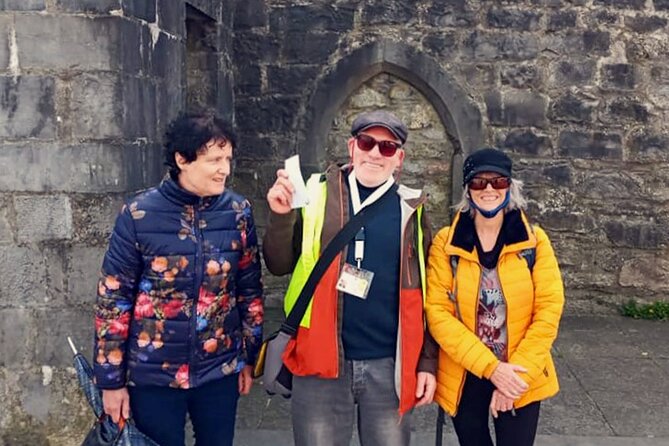
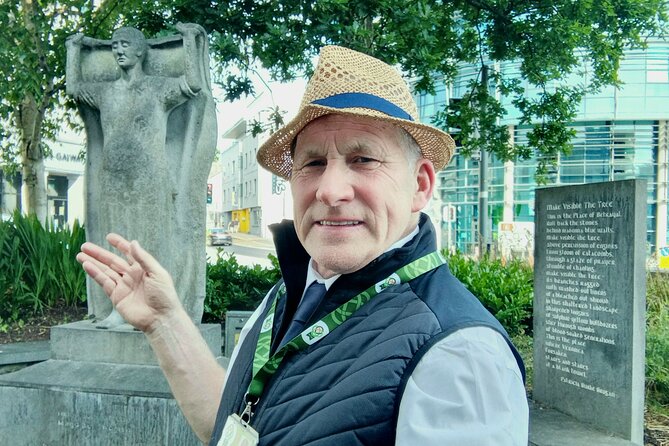
The guide, Ger Considine, has a friendly and flexible style. He is especially good at adjusting the conversation to a group’s interests. The tour can touch on family roots, Irish words on shopfronts, local restaurants, pubs, music, and Galway’s cultural life, as well as the formal history.
More Historical Tours in Galway
- Galway: Dark History Guided City Walking Tour
★ 4.8 · 236 reviews - The Dark History Tour of Galway City
★ 5.0 · 146 reviews - Galway City on Foot with Seán: Stories, History, Local Tips, Chat and More..
★ 5.0 · 64 reviews
Eyre Square and the Tribes of Galway
Your first section takes place around Eyre Square and lasts about 13 minutes. It is more than a quick orientation. The guide points out the Browne Doorway, banners representing the Tribes of Galway, the John F. Kennedy memorial, the Quincentenary Fountain, and the O’Connaire statue.
The Browne family was one of Galway’s important merchant clans, and the doorway is a small but telling reminder that the city’s power once rested with local families who traded and controlled property. The banners help explain the idea behind Galway’s traditional Tribes, the merchant families who shaped public life.
The Kennedy memorial adds a modern connection. John F. Kennedy visited Galway, and the city has long valued its links with Boston and the wider Irish diaspora. This is a good place to ask questions if your own family has roots in the west of Ireland.
Eyre Square is also useful for getting your bearings. You are not yet deep in the medieval lanes, but you are about to leave the modern civic center and enter streets where old family names, churches, and trading routes still shape the city.
Williamsgate Street and the city’s small details
The next section on Williamsgate Street takes about six minutes. You pass the elegant Browne Thomas building and jewelry shops associated with the Claddagh ring.
The Claddagh design, with its heart, hands, and crown, is closely tied to Galway. The shops are not simply decoration. They offer a chance to connect a familiar Irish symbol with the city where it became famous.
If timing allows, you may also pause at the Oscar Wilde statue. The statue was given to Ireland by Estonia in 2004, an unusual detail that makes the stop more memorable than a standard literary marker.
This part of the route is short, but it shows one of the tour’s strengths. Galway’s story often appears in shopfronts, statues, and small street details rather than in grand monuments alone.
Franciscan Friary, Courthouse Square, and the River Corrib
The route turns down Eglinton Street and passes the Franciscan Friary church. Behind it is a small graveyard that was an important burial place during the mid-17th and early 18th centuries.
You then continue to Courthouse Square, where Galway once had two important courthouses, one for the city and one for the county. One remains, with the Town Hall Theatre opposite it. The stop takes only about five minutes, but it adds useful context about how Galway was governed and how civic life changed over time.
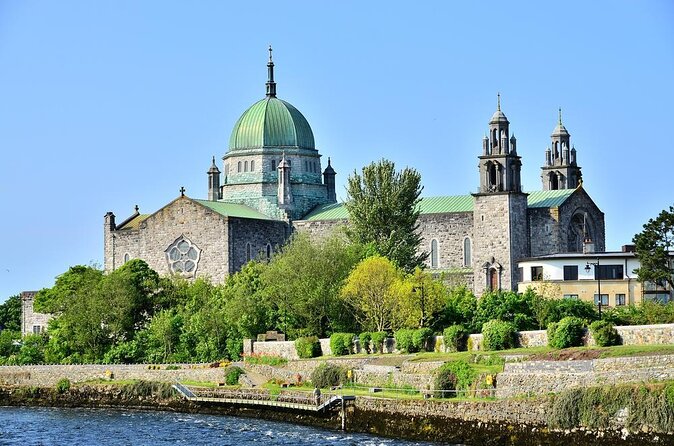
The walk then reaches a pedestrian bridge over the River Corrib. From here, you pause to view Galway Cathedral and the Franciscan Chapel. Galway Cathedral is described as Europe’s newest stone cathedral, a striking contrast to the medieval buildings earlier in the route.
The bridge offers a natural break in the walk and a good place to take photographs. It also helps you understand why the river matters so much to Galway’s layout. The route does not spend a long time at the cathedral, so if you want an extended interior visit, you will need to return separately.
More Private Tours in Galway
- Private Cliffs of Moher Day Tour
★ 5.0 · 217 reviews - Galway Private Walking Tour
★ 5.0 · 62 reviews - Full Day Private Tour to Ireland
★ 5.0 · 32 reviews - Galway: Private transfer to & from Shannon Airport | Premium Cars
★ 5.0 · 15 reviews
Lynch’s Castle and the story of Galway’s powerful families
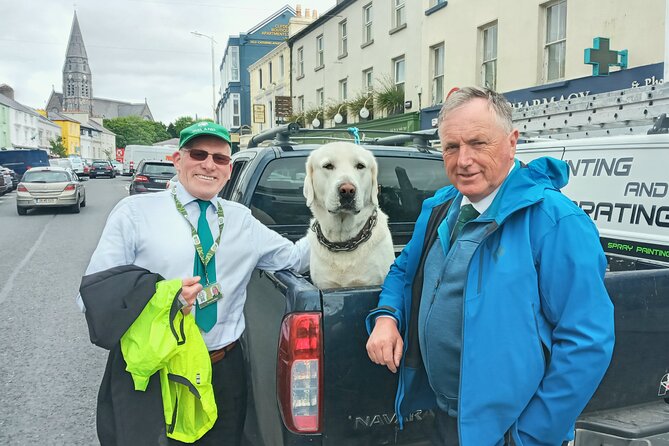
The walk returns along the River Walk before reaching Lynch’s Castle. This is one of the tour’s most worthwhile stops, even though it is not a castle in the grand, open-country sense.
Lynch’s Castle is a surviving town castle, built into the central streetscape. It belonged to the powerful Lynch family, one of Galway’s merchant clans. The guide explains the building’s crests and roundels, giving you a way to read its stonework instead of merely photographing the facade.
This is where the tour’s family-centered approach pays off. Galway’s past can seem complicated, with Norman influence, local Irish families, English rule, religious change, and overseas trade all overlapping. Lynch’s Castle gives that story a physical address.
You spend about 15 minutes here, longer than at many other outdoor stops. That allows time for questions and for the guide to explain how a fortified family residence could sit directly on a busy city street.
Church Lane, the Lynch Memorial, and Nora Barnacle
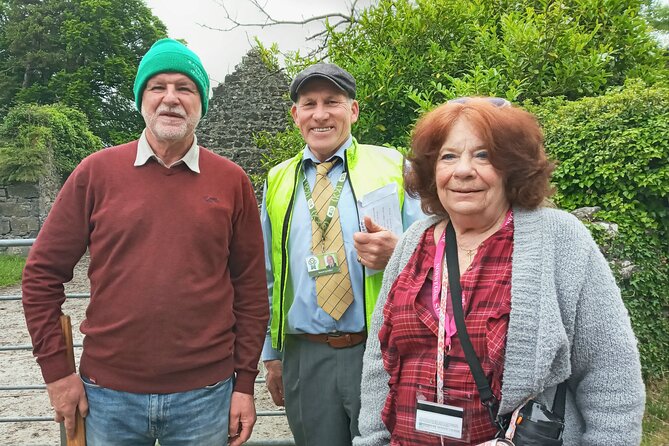
The route turns into Church Lane, once known as Dead Man’s Lane because funeral processions used it on their way to an old graveyard. You then continue through Market Street and hear about the churchyard of St. Nicholas.
The Lynch Memorial brings one of Galway’s most famous and unsettling legends. The story says that Mayor Lynch hanged his own son at this location after accusing him of murder. The memorial window, erected in 1854, keeps that tale alive.
The guide presents this as legend and local tradition, which is the right way to approach it. Galway’s old stories often mix documented events with later storytelling. The pleasure is not only deciding what is fact, but seeing how the story became part of the city’s identity.
Near Bowling Green, you pass the former family home of Nora Barnacle. She was a Galway woman who later became associated with James Joyce. Their relationship began on June 16, 1904, the date now known as Bloomsday.
This stop broadens the tour beyond medieval Galway. It shows the city’s place in modern Irish literature and gives you another reason to notice residential buildings that might otherwise pass without comment.
Entering St. Nicholas’ Collegiate Church
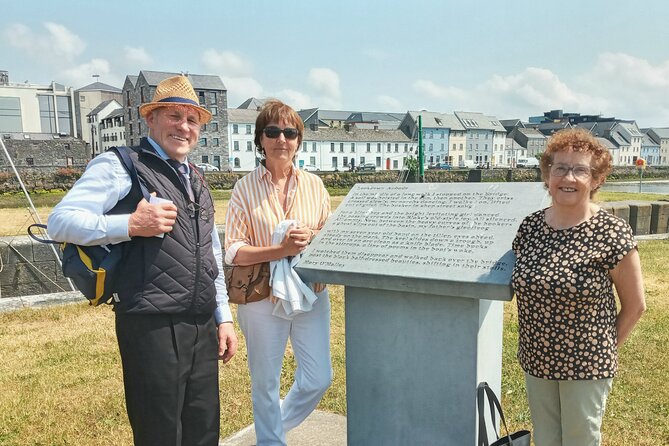
St. Nicholas’ Collegiate Church is the tour’s main included interior visit. Your guide explains the building before you look around inside.
The church is the largest medieval church in Ireland still in continuous use. It began as a Catholic church and now functions as a Protestant church, reflecting the religious changes that shaped Irish public life.
Christopher Columbus is said to have worshipped here in 1477 before his voyage of discovery. Treat that as a long-standing tradition rather than a fully proven event, but it is an engaging link between Galway’s trading past and the wider Atlantic world.
The church is a strong reason to choose this walk over a route that stays entirely outdoors. Medieval stonework, religious history, and local stories come together in one place. The visit itself is listed as about eight minutes, so do not expect a full church tour during the walking experience.
A voucher toward a separate church visit is included for the 10am and 1pm tours only. Guided church visits operate at listed times on weekdays, including 11am and 2pm, with additional Wednesday times at noon and 3pm. Confirm the timing when you book if seeing the church inside is essential to your plans.
Galway’s Latin Quarter and old port
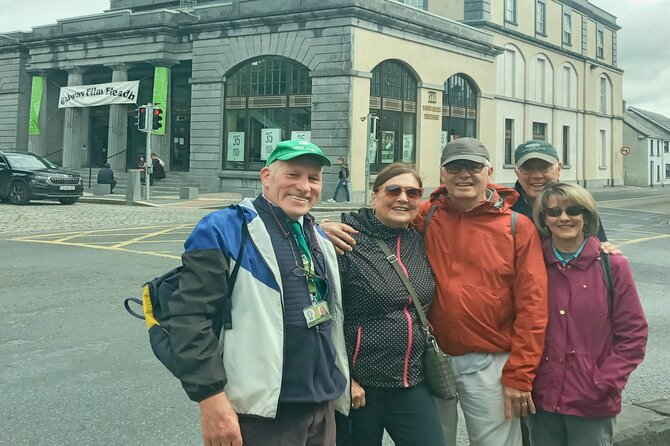
After St. Nicholas’ Church, the route enters High Street in Galway’s Latin Quarter. This is one of the city’s most recognizable areas, with pubs, shops, restaurants, and historic facades close together.
The King’s Head Pub comes with a dramatic story. Local tradition says Oliver Cromwell gave the site to the executioner of King Charles I as payment. The guide can help separate the memorable legend from the building’s place in Galway’s broader story.
You also pass Naughton House, once owned by Humanity Dick Martin, an Irish member of the British Parliament. These stops are valuable because they connect politics, local personalities, and the street-level city you see today.
The Latin Quarter is likely to be lively, and that can make outdoor explanations harder to hear. A private group helps because you can stop at the edge of the street and ask the guide to repeat a point rather than being carried along by a large crowd.
Spanish Parade and the medieval Hall of the Red Earl
The Spanish Parade once formed part of Galway’s old port. Until 1840, ships from Spain arrived with wine and spices for local merchant families. The Spanish Arch nearby is the obvious landmark, but the open space becomes more meaningful once you know it was connected to trade.
This is one of the clearest places to understand Galway’s international outlook. The city was not only a local market town. Its merchant families maintained strong commercial ties with Spain and other ports.
The route then loops back toward the Hall of the Red Earl. This was the residence of Richard de Burgo, a powerful Norman figure, and it remained important until the late 16th century. The ruins were lost for centuries before archaeologists found them in the late 1990s.
The Hall of the Red Earl is a particularly good stop for anyone who likes archaeology. It is not a grand monument with a complete facade. Its value lies in what was recovered and in the reminder that Galway’s medieval center still contains layers beneath the modern streets.
Galway as a city of theatre and Irish language
The final part of the walk turns toward Galway’s cultural life. You pass the Druid Theatre, founded by university graduates in 1975. The company has maintained close ties with writers including Tom Murphy and Martin McDonagh, and many Irish actors and directors have worked with it.
This stop helps explain why Galway is known not only for old stone buildings but also for theatre, writing, and performance. It gives you a practical idea of what to seek out if you have another evening in the city.
On Middle Street, you pass An Taibhdhearc, Ireland’s only Irish-language theatre. It was established as a major cultural project in the early 1920s, after Ireland became a Free State. Micheál Mac Liammóir served as its first director and manager from 1928.
The walk also touches on the Augustinian Order, which arrived in Galway around 1500 and established an abbey in the Forthill area. Cromwell’s forces banished the order for a time, but the Augustinians returned in 1760 and established the building connected with the route.
The final stop is the Gothic and Tudor Revival-style former cathedral on Middle Street and Abbeygate Street Lower. It served for centuries but was considered inadequate by Bishop Michael Browne in 1957. This ending brings the story back to religious buildings and the way a growing city outgrew older institutions.
What the private format adds
The price is $150.60 per group of up to 13 people, not per person. For a couple, that is a fairly costly walking tour. For a family or small group, the math improves quickly, especially since the guide can adapt the route and the entire group receives personal attention.
The private setup is most useful when your group has mixed interests. You might ask for more family history, spend longer on church architecture, or focus on food and pub suggestions. Ger has also helped with photographs and offered advice about restaurants, fish and vegetarian options, pubs, local music, and other things to do.
The group size can reach 13, so private does not always mean intimate. A group of that size may still need to stay close to the guide on windy or crowded streets. One reported experience involved a larger-than-expected group because of staff changes, so confirm the arrangement if a small group is especially important to you.
The tour is offered in English and lasts about 1 hour 55 minutes. It begins and ends at The Hardiman in Eyre Square. No transport is included, and you should budget separately for food, drinks, gratuities, and personal expenses.
Weather, mobility, and timing
Galway’s weather can change quickly, and this is an outdoor walking activity. Wear shoes suitable for city streets and bring rain protection. Poor weather may lead to a new date or a full refund, but wind and rain can still make parts of a scheduled tour less comfortable.
The experience requires good weather, yet the guide has handled wet conditions and used the indoor church visit when possible. A shortened version can be arranged for people with mobility issues, and the small team has emergency plans in place. Ask about the shortened route before booking if walking for nearly two hours would be difficult.
Most people can take part, and service animals are allowed. Public transport is nearby. Since the meeting point is central and the tour returns there, you do not need private transportation.
Free cancellation is available until 24 hours before the start time. Changes or cancellations within that window are not accepted for a refund. The experience carries a 4.6 rating from 26 reviews, with 92 percent of customers recommending it, which fits its strongest qualities: clear local context, a pleasant guide, and a route that helps you understand Galway quickly.
Who should book this Galway history tour?
I would choose this for a first visit, especially if you want the city to make more sense before exploring on your own. It is also a good match for families because the route can be adjusted and the guide can keep younger participants involved with stories about castles, legends, kings, criminals, writers, and old streets.
History fans will get the most from it. The tour moves quickly through several centuries, and you need to enjoy listening to names, dates, buildings, and local traditions. If you want a simple stroll focused on photographs, music venues, or food tastings, this may feel too detailed.
The tour also suits anyone researching Irish family roots. Galway’s merchant clans, the Tribes, the Lynch family, and the guide’s willingness to discuss connections make it easier to link a personal family story to the city.
Should you book it?
Book this tour if you want a personal introduction to Galway’s past, prefer asking questions, and value local stories as much as famous landmarks. The church visit, private format, and useful city orientation make the group price reasonable for families or several friends.
Think twice if you are traveling alone on a tight budget, dislike long history explanations, or need a fully weatherproof activity. For the best chance of using the St. Nicholas Church voucher, choose the 10am or 1pm departure and confirm the church schedule before you go.
FAQ
Where does the Galway history walking tour begin?
The guide meets you at the front entrance of The Hardiman hotel in Eyre Square, Galway.
Where does the tour finish?
The walk ends back at the meeting point at The Hardiman in Eyre Square.
How long does the tour last?
The tour lasts approximately 1 hour 55 minutes.
How many people can join the private tour?
The price covers one private group of up to 13 people. Only your group is scheduled to participate.
Is St. Nicholas’ Collegiate Church included?
A voucher toward a visit to St. Nicholas’ Church is included for the 10am and 1pm tours only. The walking tour includes an explanation of the church and a visit to it, subject to opening and operating arrangements.
What language is the tour offered in?
The tour is offered in English.
Is transportation included?
No. Transportation to and from the meeting point, private transportation, accommodation, meals, drinks, and personal expenses are not included.
Can people with mobility issues join?
A shortened version of the city tour can be offered to people with mobility issues. Ask the provider about the suitable route before booking.
What happens if bad weather cancels the tour?
If the supplier cancels because of poor weather, you will be offered another date or a full refund. You can also cancel for a full refund if you do so at least 24 hours before the start time.
More Walking Tours in Galway
- The Welcome to Galway Walking Tour
★ 5.0 · 427 reviews - Galway: Welcome to Galway Walking Tour
★ 4.8 · 338 reviews - Walking and Tasting Tour of Galway City
★ 5.0 · 283 reviews - The Legendary Walking Tour of Galway
★ 5.0 · 230 reviews
Just added around Galway
- City Sightseeing Galway Hop-On Hop-Off Bus Tour★ 4.0 · 134 reviews
- Aran Knitting, History and Heritage in the Burren★ 5.0 · 11 reviews
- Abalone farm tour and tasting with coastal seaweed walk. Guided. 2 hours★ 5.0 · 4 reviews
- Guided Tour of Aillwee Cave and Visit to the Birds of Prey Centre★ 4.0 · 14 reviews
- Cliffs of Moher, Aran Island & Burren tour from Galway. Guided.★ 4.5 · 65 reviews
- Aran Island, Cliffs of Moher & Cruise tour from Galway. Guided.★ 5.0 · 137 reviews
- Oyster Farm and Tasting Experience★ 4.5 · 33 reviews
- History & cultural tour of Inishmore, Aran Islands. Galway. Private. 2 ½ hours★ 3.5 · 13 reviews
Historical Tours, compared.

Dublin Historical Centre Food Tour with 8 Food Tastings & Drinks
Read our review →
Historical 2-Hour Guided Walking Tour of Dublin
Read our review →
Dublin to Cork, Blarney Castle & Cóbh Heritage Centre by train
Read our review →
Jeanie Johnston Tall Ship Irish Famine History Tour
Read our review →

Deliciously Dublin: The Artisan Donut Walking & History Tour
Read our review →Browse the lists this tour appears in