
Reviewed · IRISH MUSIC & DANCE SHOWS
Dublin Traditional Irish Music Walking Tour with Live Performance
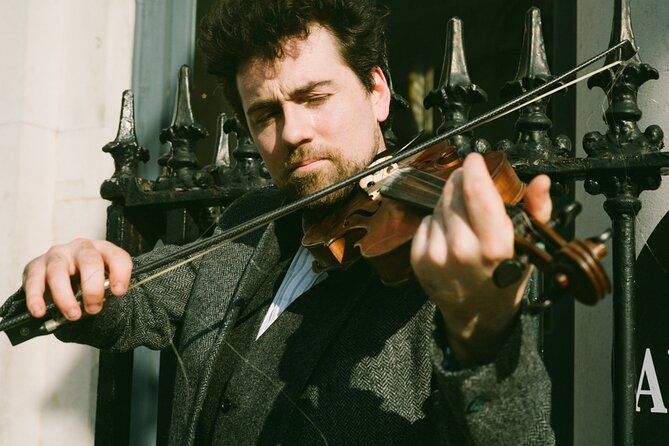
Dublin’s past comes alive here through songs, poems, and stories, not a long stream of dates. Your guide is an Irish musician, and the route links Temple Bar, the River Liffey, medieval streets, Dublin Castle, and two cathedrals with live performance along the way. I like the way a song can explain a place’s social or political past better than a plaque can.
I also like the compact route and comfortable pace. The walks between stops are short, and the group is capped at 20 people, though some sessions are much smaller. Guides such as Ciaran, Sean, Dylan, and Shaun have drawn particular praise for their singing, humor, poetry, and command of Dublin’s musical traditions.
The main caution is practical: this is an outdoor performance in central Dublin. Street noise can make a soft-spoken guide hard to hear, and one booking party once joined the wrong walking group because two tours met nearby. Arrive early, confirm the music tour, and stay close to the guide.
Key points to know before you book
- Music carries the story: Each stop pairs Dublin history or folklore with a related Irish song, ballad, poem, or tale.
- A useful central route: You walk from Temple Bar through Fishamble Street and across the Liffey, finishing at St Patrick’s Cathedral.
- Small-group format: The maximum is 20 people, with some departures described as groups of six or nine.
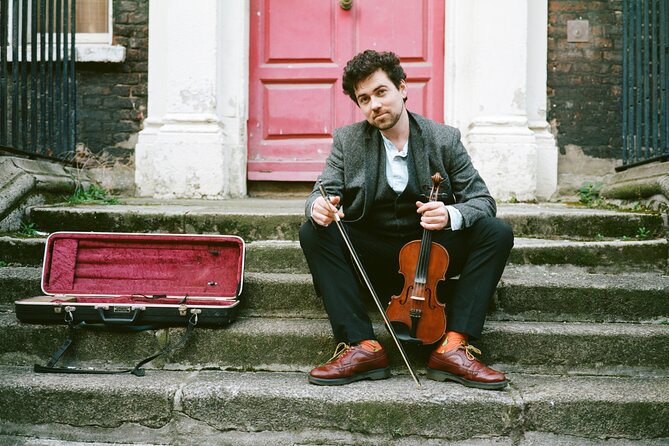
- Guides are working musicians: Ciaran, Sean, Dylan, and Shaun are among the guides praised for singing, instruments, humor, and storytelling.
- Good value at $27.81: Two hours of live music plus a city orientation costs less than many formal attraction tours, although cathedral entry is not included.
- Book with your ears open: Street noise, a late guide, or a mixed-up meeting point can affect the experience, so confirm the group at Crown Alley.
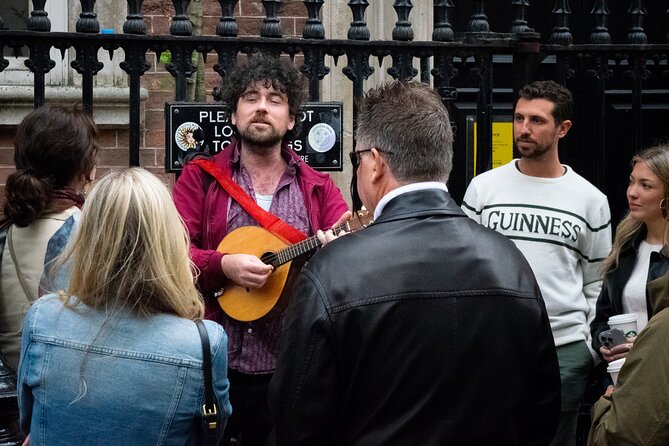
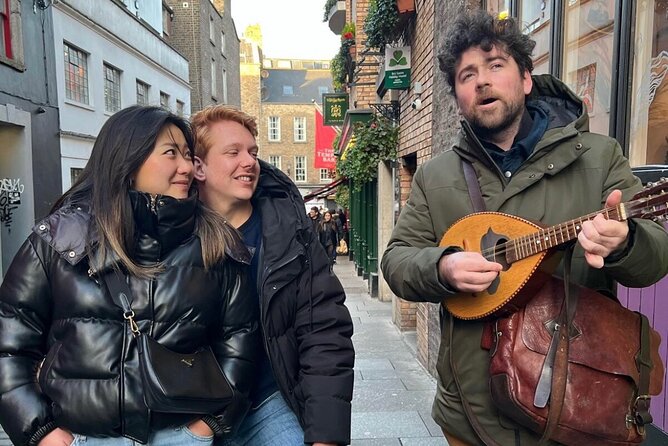
Dublin told through a guitar, mandolin, and human voice
This is not a standard walking tour with a musician added as a small extra. The performance is the organizing idea. You move through central Dublin while your guide explains the meaning of a place, then connects it to a traditional song or piece of folklore.
That format gives you a different way to read the city. Fishamble Street is not simply an old lane. It becomes a place tied to Viking Dublin and the first performance of Handel’s Messiah. Christ Church Cathedral is not just a handsome church. It becomes a setting for stories about medieval and Victorian Dublin, including some of the city’s darker tales.
The songs also give the tour its social edge. Dublin’s music can carry stories about work, hardship, politics, neighborhoods, faith, and rebellion. Guides have used an eclectic mix of traditional songs, occasional Gaelic, poetry, and humor, so you are not getting the same tune repeated at every stop.
You may also be invited to sing or move along. That participation is part of the charm, but you do not have to be a natural performer. The tone is playful rather than formal, and one initially reluctant participant ended up singing, dancing, and laughing by the end.
More Walking Tours in Dublin
- Dublin Highlights and Hidden Gems Guided Walking Tour
★ 5.0 · 6,020 reviews - Dublin: Highlights and Hidden Gems Walking Tour
★ 4.9 · 2,140 reviews - 1916 Rebellion Walking Tour
★ 5.0 · 1,605 reviews
Starting at 1 pm in Temple Bar
The tour begins at 1:00 pm at 3 Crown Alley, in Temple Bar, Dublin. This is an easy city-center meeting point, but Temple Bar can be crowded and confusing, especially when several walking groups gather nearby.
I would arrive a little early. Confirm that you are joining the traditional Irish music tour, not a regular historical walk. A previous mix-up left a booking party waiting with another group, and the problem was not discovered until the music failed to appear. The experience provider is Original Dublin, and you receive confirmation at booking with a mobile ticket.
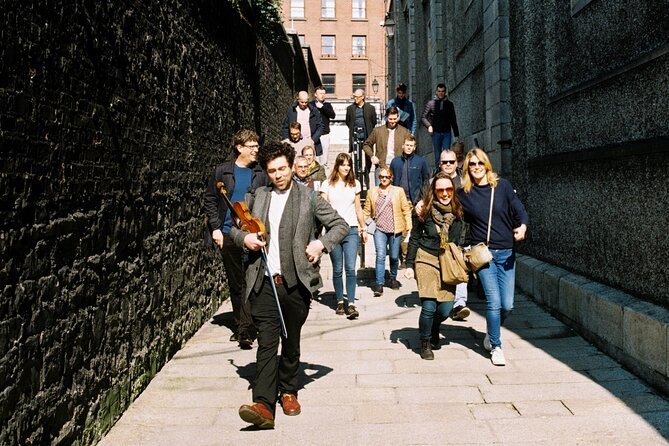
The opening minutes set the mood. Instead of a formal introduction followed by a long lecture, your guide begins placing Dublin’s streets in a musical and historical frame. The route then moves through narrow lanes and open city spaces, with short talks and performances at each stop.
The published duration is about two hours. That is long enough to cover a useful slice of central Dublin without consuming an entire afternoon. It also leaves time afterward for the cathedral area, a pub, lunch, or another city sight.
Smock Alley Theatre and Temple Bar’s older face
The first named stop is Smock Alley Theatre 1662, described as Ireland’s oldest theatre. It sits in the heart of Temple Bar, an area many people know mainly for pubs and nightlife.
The theatre gives the tour an early chance to connect entertainment with city history. You spend about 10 minutes here, with no separate admission charge included or required for the stop. Expect an explanation of the site and a musical or theatrical link rather than a full indoor theatre visit.
This distinction matters. If you are hoping to enter every building on the route, this is not that sort of tour. The value comes from seeing the exterior settings and hearing the stories attached to them while your guide performs.
Grattan Bridge and the River Liffey
From Temple Bar, the route reaches Grattan Bridge, one of the picturesque crossings over the Liffey. Seahorse lanterns decorate the bridge, and it connects Capel Street with Parliament Street.
This is a good visual pause. You can take photographs, watch the city move around the river, and hear how the bridge fits into Dublin’s older street pattern. The stop lasts about 10 minutes and involves no admission fee.
The river crossing also breaks up the walking route. The tour is not a march from one major attraction to another. Short intervals between stops keep the pace manageable, while the music gives you a reason to pause instead of rushing past the scenery.
Street noise is the concern here and elsewhere. One person found it hard to hear a guide during a larger historical walk, with traffic and passing pedestrians competing with the commentary. Stay near the performer, and if the group spreads out, move toward the front.
More trad music and dancing nights:
- The Irish Dance Party in Dublin
★ 5.0 · 918 reviews - Dublin: Irish Music and Dance Show with Dance Lesson
★ 4.7 · 567 reviews - Dublin: Irish Music Walking Tour with Live Performance
★ 4.8 · 137 reviews - Galway: Trad on the Prom Ticket with Irish Music and Dancing
★ 4.9 · 482 reviews
Fishamble Street, Vikings, and Handel’s Messiah
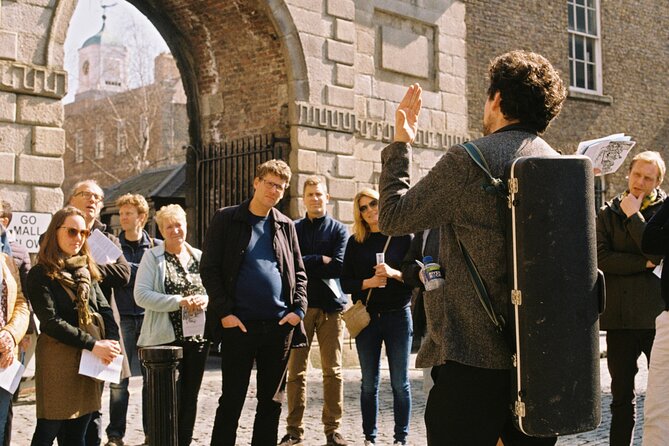
Fishamble Street is one of the most interesting stops because several layers of Dublin meet in one place. It is often described as the city’s oldest street and was once part of the largest Viking settlement found outside Scandinavia.
The street also has an important musical connection. The first performance of Handel’s Messiah took place here. That gives your guide a natural opening to explain how Dublin’s public music life developed and how performance has long been part of the city’s identity.
This is where the tour’s method makes the most sense. A conventional guide might provide the facts and point toward a building. A singing guide can add a ballad or related piece, then explain why the music belongs to the story. The result is easier to remember and more personal without needing a large attraction ticket.
The stop is about 10 minutes. That sounds brief, but the short format helps maintain the tour’s rhythm. You get a focused story, a performance, and time for photographs before moving on.
Christ Church Cathedral and medieval Dublin
Christ Church Cathedral is the historical center of the route. Its medieval foundations and later Victorian decoration bring several periods together, and the surrounding streets help explain how Dublin grew around its religious and civic institutions.
The tour explores some of the cathedral and its setting from the outside and nearby areas. The stop does not include a cathedral admission ticket, so do not book this experience expecting a full interior visit. If seeing the inside matters to you, plan a separate visit and check the cathedral’s opening arrangements independently.
The musical treatment here focuses on darker stories from medieval and Victorian Dublin. That adds a welcome change of tone. Irish music is not only cheerful pub tunes and group singing. Traditional material can carry grief, fear, conflict, and moral warning, and a skilled guide can use those shades to make the cathedral area feel more than scenic.
Guides named Ciaran and Dylan have been praised for explaining the background to each song before performing it. That context helps if you do not already know Irish folk music. You are not expected to recognize every melody or understand every reference on your own.
Dublin Castle and Ship Street Gate
The next stop is Dublin Castle, specifically the Ship Street gate and some famous city steps. Again, the tour uses the surroundings as a stage rather than taking you through the entire castle complex.
This is useful for orientation. Dublin Castle connects the historic center with the political story of the city, while the nearby lanes show how old Dublin can feel close and intimate. Your guide can shift from architecture to song, linking the site with the people and events remembered in Irish music.
Allow time for photographs here, but keep your attention on the guide. A song performed outdoors can be easy to miss if you lag behind while taking pictures. The route is short, and the group needs to remain together for the performance to work.
The castle stop also shows the limits of the $27.81 price. You are paying for a guided walk and live entertainment, not entry to Dublin Castle, Christ Church Cathedral, or St Patrick’s Cathedral. For many people, that is a fair trade, especially if they want an overview before deciding which interiors deserve a separate visit.
Finishing in St Patrick’s Park
The tour ends at St Patrick’s Park, beside St Patrick’s Cathedral, at St Patrick’s Close. This is a pleasant finish because you are left near one of Dublin’s best-known landmarks rather than returned to the original meeting point.
The final stop gives the experience a clear endpoint and leaves you well placed for the rest of your day. You can photograph the cathedral, continue exploring the area, or use the guide’s suggestions for pubs and restaurants. Sean, in particular, has been praised for offering useful directions and recommendations after the formal tour ended.
The cathedral itself is not included as an admission visit. Think of the park and exterior as the conclusion to the walk. If you want to go inside, plan that separately.
Ending here also makes the route feel purposeful. You have crossed a section of the old center, followed the Liffey, passed theatrical and religious landmarks, and reached a major cathedral through a sequence of songs. It is a better introduction to central Dublin than simply ticking off monuments from a sidewalk.
How the guides shape the experience
The guide matters more here than on a basic sightseeing walk. You are not just following a route. You are listening to a live performer manage history, timing, audience energy, and the practical problem of singing in public streets.
Ciaran has been praised for humor, poetry, historical detail, and a varied collection of songs. Sean has been described as a strong singer and musician with an easy Irish wit. Dylan has tied each song closely to the place and explained music in Gaelic as well as English. Shaun has used a mandolin and handled an impromptu request for Cockles and Mussels.
These details point to a flexible style. The exact songs may change, and the guide may respond to the group. That is a strength if you like live performance and surprise. It is less ideal if you want a fixed script, a quiet lecture, or a carefully amplified concert.
The guide’s voice is also important. Most people can participate, but central Dublin is not silent. If you have trouble hearing in busy streets, stay close and ask to move nearer the front. A group of six or nine will feel more intimate than one approaching the 20-person limit.
Who will get the most from this walk
I would recommend this tour most strongly to people who want Dublin’s culture, not just its buildings. It suits first-time visitors who want a compact introduction, music lovers who enjoy traditional Irish material, and couples or families looking for something more active than a pub performance.
It is also a good choice if you enjoy learning why a song exists. The guide does not simply sing for decoration. The best moments connect a tune with a street, a landmark, or a piece of Dublin’s social and political past.
You may want another type of tour if your main goal is detailed architecture, full cathedral interiors, or a quiet explanation of every monument. The historical information is woven into a performance, so the depth varies with the guide and the group.
The walking itself is moderate in distance, with short stretches between stops. The activity information says most people can participate, and service animals are allowed. It is near public transportation, and the central start and finish make it easy to fit into a day of sightseeing.
Is $27.81 good value?
At $27.81 per person, the tour offers two hours of walking, live traditional music, short historical talks, and a route through several major parts of central Dublin. I consider that good value if you would otherwise pay for a separate music session and a city orientation.
You are not paying for entry to the cathedrals or castle, and that should be clear before booking. Still, the performances provide something a standard free walk cannot easily match. A well-timed song can make Fishamble Street or Christ Church more memorable than a list of dates.
The 98 percent recommendation rate and 4.9 rating from 253 ratings indicate a very strong record, but the less successful experiences point to real risks. A late start, unclear group identification, or poor hearing conditions can undermine the event. Those problems do not define the tour, but they are reasons to arrive early and keep the guide in sight.
Free cancellation is available up to 24 hours before the 1:00 pm start for a full refund. Changes or cancellations inside that 24-hour window are not accepted for a refund, based on local time.
Should you book the Dublin music walk?
Book it if you want to see central Dublin through live Irish music and local storytelling, and if you are happy with an outdoor group experience rather than a formal attraction tour. The combination of Temple Bar, the Liffey, Fishamble Street, Christ Church, Dublin Castle, and St Patrick’s Cathedral gives you a strong two-hour orientation.
I would be especially inclined to book if this is your first visit or if you already enjoy folk music. Go in ready to listen, perhaps sing along, and take part in a little movement if the guide invites it. Arrive early at Crown Alley, confirm the music group, and stay close enough to hear.
Skip it if you want a silent, highly structured walk or guaranteed cathedral interiors. For everyone else, this is an inexpensive way to connect Dublin’s streets with the songs that have carried its stories through generations.
FAQ
Where does the Dublin Traditional Irish Music Walking Tour begin?
It begins at 3 Crown Alley, Temple Bar, Dublin, at 1:00 pm.
Where does the tour finish?
The tour finishes at St Patrick’s Park beside St Patrick’s Cathedral, at St Patrick’s Close, Dublin.
How long does the tour last?
The experience lasts approximately two hours.
What landmarks are included on the route?
The route includes Smock Alley Theatre 1662, Grattan Bridge, Fishamble Street, Christ Church Cathedral, Dublin Castle, and St Patrick’s Cathedral.
Is admission to the cathedrals or Dublin Castle included?
No admission tickets are included for these attractions. The tour visits the landmarks and surrounding areas as part of the walk.
How many people can join the tour?
The maximum group size is 20 people.
Is the tour suitable for most people?
The activity information says most people can participate. Service animals are allowed, and the tour is near public transportation.
What happens if I need to cancel?
You can cancel at least 24 hours before the start time for a full refund. Cancellations or changes made less than 24 hours before the start time are not refunded.
How much does the experience cost?
The listed price is $27.81 per person.
Just added around Dublin
- Women Of Ireland: Trailblazers & Pioneers★ 5.0 · 4 reviews
- Wicklow tour of Glendalough★ 4.5 · 8 reviews
- Full Day Private Wicklow Tour★ 5.0 · 12 reviews
- Wicklow Mountains & Glendalough Luxury Private Day Tour★ 5.0 · 23 reviews
- Premium Irish Whiskey Tasting Hosted by Local Dublin Expert★ 5.0 · 77 reviews
- Whiskey Tasting Tour of Dublin★ 5.0 · 117 reviews
- Dublin To Kilkenny Castle Waterford Crystal Private Car – Day Tour★ 5.0 · 8 reviews
- Historical Walking Tour of Dublin★ 5.0 · 50 reviews
Irish Music & Dance Shows, compared.

Trad on the Prom Ticket with Irish Music and Dancing
Read our review →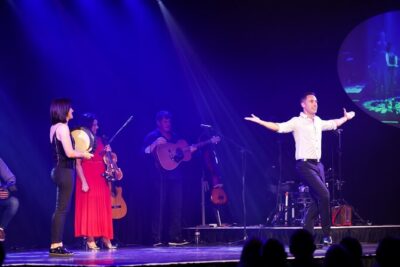
Trad on the Prom – Ireland’s #1 Music, Song & Dance Experience
Read our review →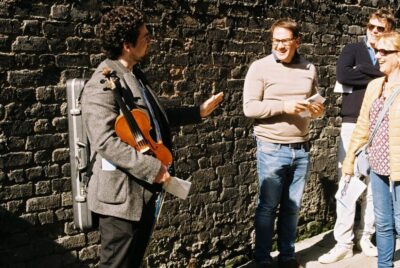
Browse the lists this tour appears in