
Reviewed · WALKING TOURS
Dublin: Hidden Gem Walking Tour with Local Guide
Tallaght’s story reaches far beyond modern apartment blocks and shopping centers. On this two-hour walk, local guide Sophie connects ancient monasteries, Irish poets, war correspondents, aviation, chocolate factories, and the explosive growth that changed Tallaght from a rural village into one of Ireland’s largest urban areas.
I like the small maximum group of 12, which should make it easier to ask questions, and I like the way the tour uses original letters, poems, photographs, and bilingual Irish-English material. The views toward the Dublin Mountains add a welcome sense of place.
The main consideration is that this is a history walk through an urban district, not a postcard tour of central Dublin. Some stops are beside roads, retail areas, or modern buildings, and the experience depends on good weather.
Key points to know before you book
- Tallaght’s overlooked story: Learn how a rural settlement changed rapidly during the 1970s and 1980s.
- Katharine Tynan and Alice Furlong: Meet two important women writers linked to Tallaght and Irish cultural life.
- Rare local detail: The route covers the former Tallaght Aerodrome, Urney Chocolates, Jacob’s, and the Dublin and Blessington Steam Tramway.
- Irish mythology and language: Hear Oisín in the Land of Youth in Irish and English, then learn a few basic Irish phrases.
- Compact, low-cost format: The tour costs $18.05 per person, lasts about two hours, and has a maximum of 12 participants.
- A local ending: The walk finishes in Tallaght Village beside a bilingual Irish-English café.
Why this Tallaght walk is different from a central Dublin tour
Most first-time Dublin visitors stay around Trinity College, Temple Bar, Dublin Castle, and the River Liffey. Those places deserve attention, but they tell only part of the city’s story. Tallaght, on Dublin’s southwestern edge, offers a look at how Ireland changed outside the historic center.
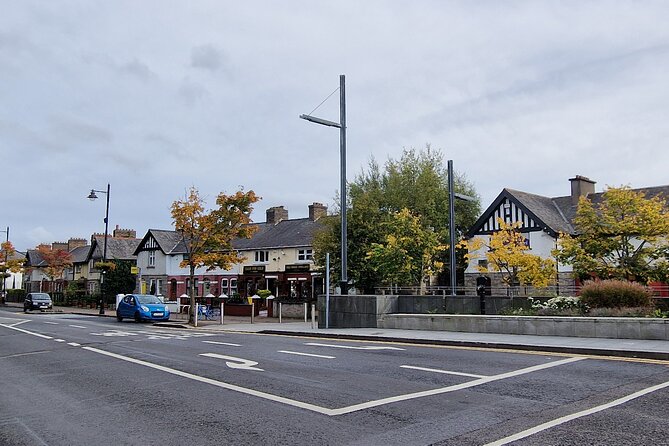
The tour begins in Kingswood, near Kilnamanagh, and ends in Tallaght Village. That route matters. You are not simply moving between famous monuments. You are watching the area shift from old village and monastery country into a large urban center shaped by industry, housing, transport, unemployment, and migration.
Sophie’s approach is personal and local. She grew up with a close connection to Tallaght and presents the area through people who lived, worked, wrote, reported, prayed, and built here. The tour also corrects the easy assumption that Tallaght is only a modern suburb. Its older story reaches back to early Irish Christianity, while its later story involves figures known far beyond Ireland.
You should come ready to listen rather than expect a long list of grand buildings. The interest lies in the connections: a poet’s home, a war correspondent’s birthplace, an aerodrome on family land, a chocolate company remembered by generations of Irish people, and a village that once had a steam tram link with Dublin.
More Walking Tours in Dublin
- Dublin Highlights and Hidden Gems Guided Walking Tour
★ 5.0 · 6,020 reviews - Dublin: Highlights and Hidden Gems Walking Tour
★ 4.9 · 2,140 reviews - 1916 Rebellion Walking Tour
★ 5.0 · 1,605 reviews
Kingswood and the first Tallaght stories
The opening stop in Kingswood is brief, about five minutes, but it sets the tone. Sophie introduces Tallaght and its beginnings in ancient Irish history before moving into the area’s literary and political connections.
The next stop is outside Whitehall, the former home of Katharine Tynan. This is one of the strongest parts of the route for anyone interested in Irish writing. Tynan was a major literary figure who moved within both Irish and English literary circles. She also had friendships with W. B. Yeats and George William Russell, known as AE.
You hear about those relationships through letters and personal connections rather than a broad lecture on Irish literature. That makes the stop more immediate. Tynan was not simply a name on a plaque. She was part of a creative network at the time of the Irish Literary Revival, and her Tallaght home became a place connected with that world.
The stop lasts about 15 minutes. It is short, so you will not receive a full biography or a survey of every book she wrote. Still, the material gives you a useful way into Irish cultural history, especially if you already know Yeats but want to understand the wider circle around him.
William Howard Russell, Dickens, and the birth of war reporting
At Belgard Road, the subject changes from poetry to journalism. William Howard Russell was born in Jobstown, Tallaght, and became one of the first famous war correspondents.
His career took him from reports on Daniel O’Connell’s meetings and the Great Famine to the Crimean War and the American Civil War. This is a surprising local connection. A quiet suburban road becomes the starting point for a career that helped shape how the public learned about wars from far away.
Sophie also brings in Russell’s friendship with Charles Dickens and shares some of Russell’s writings and letters. That use of primary material is important. It gives the story a human voice and helps explain how reporting changed during the nineteenth century.
The stop is only about ten minutes, so you should expect a concise portrait rather than a detailed study of the Crimean War or the American Civil War. The payoff is the local angle. You see how Tallaght was connected to major events in Ireland, Britain, Europe, and North America.
A bilingual legend with a Dublin Mountains view
The next Belgard Road stop turns to Irish mythology. Sophie provides a bilingual version of Oisín i dTír na nÓg, or Oisín in the Land of Youth, in Irish and English.
You do not need to speak Irish to follow the story. The English version makes the legend accessible, while the Irish text gives you a feel for the language and its sound. The tale also has a direct connection to the Dublin Mountains, which you can see from the stop.
That view gives the legend a useful physical setting. Instead of treating mythology as something sealed inside a book, the tour links the story to the hills you can see nearby. It is a small but effective moment, especially for anyone who wants more than a standard account of Dublin’s literary attractions.
This stop takes about ten minutes. It is not a mountain walk, and the tour does not head into the Dublin Mountains. You are looking at them from the urban route while hearing the story associated with them.
A few more Dublin half-days to weigh up
- Dublin to Cliffs of Moher, including Wild Atlantic Way and Galway
★ 5.0 · 23,331 reviews - From Dublin: Cliffs of Moher, Burren & Galway City Day Tour
★ 4.8 · 18,888 reviews - Dublin: Guinness Storehouse Entry Ticket
★ 4.6 · 16,863 reviews - Dublin to Cliffs of Moher, Burren, Wild Atlantic Way, Galway Tour
★ 5.0 · 12,924 reviews
Tallaght Aerodrome, Urney Chocolates, and Jacob’s
At Belgard Retail Park, the tour takes one of its most unusual turns. The area once contained Tallaght Aerodrome, which played a part during the First World War, the Irish War of Independence, and the Irish Civil War.
The aerodrome stood on land connected with Katharine Tynan’s father. Sophie shares one of Tynan’s poems about this development, bringing together aviation, family history, and literature in one stop.
The location also allows the tour to discuss the Gallagher family and the creation of Urney Chocolates. Urney became a familiar Irish brand and operated in Tallaght for many decades before closing in 1980. The name still carries a strong sense of memory for many people in Ireland, and you learn how the brand continues to exist.
Jacob’s is another important local business covered here. Its presence, along with Urney’s, helps explain how employment and industry altered Tallaght. These companies were not just names on factory gates. They affected the area’s identity and gave work to local families during an important period of change.
This 15-minute stop is especially good for visitors who like industrial and social history. It also shows the limits of the setting. You are in a retail park, not at a preserved aerodrome or chocolate museum, so much of the experience comes through Sophie’s explanation and the historical material she shares.
The fast growth of Tallaght in the 1970s and 1980s
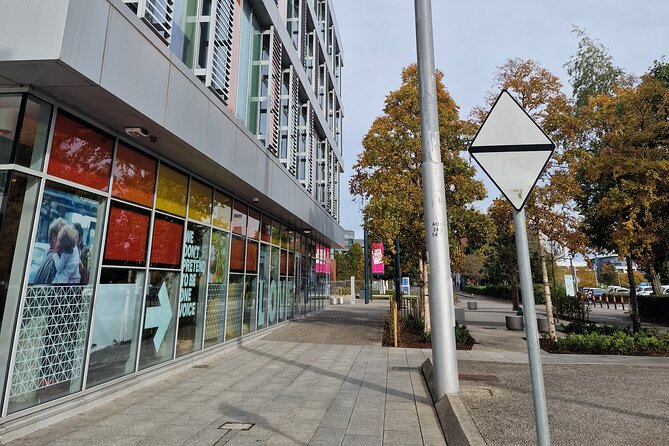
At TU Dublin’s Tallaght Campus, the tour spends about 15 minutes on the transformation of the district. During the 1970s and 1980s, Tallaght became one of Ireland’s largest urban areas and one of the fastest-growing urban centers in Western Europe.
The change happened in a difficult national climate. Ireland faced economic problems, high unemployment, and heavy emigration. Tallaght’s rapid expansion created opportunities, but it also brought pressure and changed daily life for the people who already lived there.
This part helps you read the modern town more clearly. Large housing developments, roads, schools, shops, and public institutions are not random features. They reflect a short period of intense growth and the need to house a rising population.
The tour does not present this change as a simple success story. Growth can bring jobs and services, but it can also strain communities and reshape local identity. That balance gives this section more value than a simple before-and-after account.
If you are interested in urban planning, modern Irish society, or the story of suburban Dublin, this may be the most useful part of the walk. It places Tallaght within Ireland’s wider economic and social history.
St Maelruain’s Church and the older religious center
St Maelruain’s Church of Ireland occupies the site of a former monastery. The monastery was once so important that it was described, along with the monastery at Finglas, as one of the two eyes of Ireland.
The stop lasts only about five minutes, but the location gives you a clear reminder that Tallaght’s story began long before modern expansion. Sophie discusses St Maelruain, the early religious settlement, and how the present church came into being.
You will not spend a long time inside a major cathedral or viewing a large collection of medieval objects. The value is in understanding the site beneath the current building. A modern town can hide very old layers, and this is one of the places where those layers become easier to see.
The church grounds also lead into the story of Alice Furlong, whose grave was overlooked for a long time. Her life is one of the tour’s strongest discoveries.
Alice Furlong and the Irish language
Alice Furlong was a poet, writer, and Irish-language advocate. She was also one of the founding members and a vice-president of Inghinidhe na hÉireann, or Daughters of Ireland.
Her connection with Tallaght was strong, and Sophie shares some of her poetry in both Irish and English. Professional English translations are provided for the Irish-language work, so you can appreciate the meaning as well as the sound.
This 15-minute stop gives the tour an important cultural balance. Katharine Tynan connects Tallaght with the wider literary world, while Alice Furlong shows the importance of Irish-language activism and women’s political involvement.
The story also raises a practical point about the nature of this experience. Some of the people you meet through the tour are not represented by large museums or famous monuments. Their importance comes through research, writing, graves, letters, poems, and local memory.
The Fenian Rising and Tallaght Village
In Tallaght Village, a plaque commemorates the Fenian Rising of 1867. Sophie uses the site to explain the uprising and Tallaght’s role in that period of Irish history.
Charles Dickens appears again through his writings on the events in Tallaght. That connection gives you an outside view of a local episode, while the plaque grounds the story in the village itself.
The stop lasts about ten minutes. It is a good example of how the tour moves between national events and local places. You learn about a major period in Irish political history, then see how it played out in one Dublin community.
The village is also where the walk feels most rooted in its older identity. The final stop includes cottages designed by architect Thomas Joseph Byrne, described as one of the influential architects of his day. Sophie also discusses the Dublin and Blessington Steam Tramway, which ran through the area until it closed in 1932.
The tramway story is useful because transport often explains why towns grow. Tallaght’s development was not only about factories and housing. Its connections with Dublin helped shape how people moved, worked, and built their lives.
Finishing with Irish phrases and a local café
The tour ends in the heart of Tallaght Village, beside a bilingual Irish-English café. Before you leave, Sophie teaches a few basic Irish phrases and talks briefly about the language.
This is a modest ending, but it fits the tour well. You have heard Irish in mythology and poetry, and now you get a few words you can use yourself. You are welcome to try them in the café after the walk.
The Irish-language element is not presented as a formal lesson. It is a small invitation to keep using what you heard. For visitors with Irish roots, it may be especially meaningful. For others, it offers a friendly way to engage with a part of Irish culture that can be missed on a standard Dublin itinerary.
Price, group size, and practical value
At $18.05 per person, this is an inexpensive guided experience. The price is particularly fair if you enjoy social history, literature, local stories, or modern urban change. You are getting a focused two-hour walk with a local guide, rather than paying mainly for entry to a famous attraction.
The small group limit of 12 matters. Sophie can answer individual questions, adjust the emphasis, and share written material without the walk feeling like a large crowd moving from stop to stop.
The route includes ten stops, but several are brief. That keeps the tour moving and allows it to cover a wide period, from early Irish Christianity to the twentieth-century expansion of Tallaght. The tradeoff is that some subjects receive only a short introduction.
The walk is offered in English and uses Irish-language material with English translations. It is near public transportation, and most people can take part. Service animals are allowed.
Start at Kingswood, Kilnamanagh, Dublin, County Dublin. Finish at Tallaght Village on R819. Since the walk is outdoors and requires good weather, bring suitable clothing and shoes. Poor weather can lead to a new date or a full refund.
You can cancel for a full refund up to 24 hours before the start time. The experience is often booked about 28 days ahead, so reserve early if your Dublin dates are fixed.
Who should book the Tallaght walking tour?
I would choose this tour if you have already seen central Dublin and want a different side of the capital. It also suits Dublin residents who know the roads and shopping areas but have never learned the stories behind them.
History fans will appreciate the range. You get early monastic Ireland, literary figures, journalism, rebellion, aviation, manufacturing, transport, and urban growth in one compact route.
It is also a good pick for anyone interested in overlooked people, particularly Katharine Tynan and Alice Furlong. Their stories give the tour more depth than a standard list of male political figures and military events.
You may want to skip it if your main goal is grand architecture, indoor attractions, or a relaxed scenic stroll. Some stops are in ordinary modern settings, and the value comes from the interpretation rather than dramatic buildings.
Should you book it?
Book this tour if you want to understand how Tallaght became Tallaght. Sophie’s route links local places with national stories and gives you people to remember, from Katharine Tynan and Alice Furlong to William Howard Russell and the Gallagher family.
The strongest reasons to go are the small group, low price, original letters and poems, unusual industrial stories, and the honest look at urban change. Just plan for an outdoor walk in good weather and keep your expectations focused on storytelling, not landmark sightseeing.
For an authentic, affordable look at another side of Dublin, this is a smart choice.
FAQ
How long does the Tallaght walking tour last?
The tour lasts approximately two hours.
How much does the tour cost?
The listed price is $18.05 per person.
Where does the tour start?
The tour starts at Kingswood, Kilnamanagh, Dublin, County Dublin, Ireland.
Where does the tour end?
The walk ends in Tallaght Village on R819, beside a bilingual Irish-English café.
What language is the tour offered in?
The tour is offered in English. Irish-language poems and legends are also included with professional English translations where needed.
How many people can join the tour?
The maximum group size is 12 travelers.
Can I cancel for a refund?
You can cancel at least 24 hours before the start time for a full refund. If poor weather causes the tour to be canceled, you will be offered another date or a full refund.
Just added around Dublin
- Women Of Ireland: Trailblazers & Pioneers★ 5.0 · 4 reviews
- Full Day Private Wicklow Tour★ 5.0 · 12 reviews
- Wicklow Mountains & Glendalough Luxury Private Day Tour★ 5.0 · 23 reviews
- Wicklow tour of Glendalough★ 4.5 · 8 reviews
- Premium Irish Whiskey Tasting Hosted by Local Dublin Expert★ 5.0 · 77 reviews
- Whiskey Tasting Tour of Dublin★ 5.0 · 117 reviews
- Dublin To Kilkenny Castle Waterford Crystal Private Car – Day Tour★ 5.0 · 8 reviews
- Historical Walking Tour of Dublin★ 5.0 · 50 reviews
Walking Tours, compared.
Dublin Highlights and Hidden Gems Guided Walking Tour
Read our review →
90 Minute Dublin Walking tour and Sightseeing tips
Read our review →
Historical 2-Hour Guided Walking Tour of Dublin
Read our review →
Dublin Traditional Irish 3 Course Meal Walking Tour with Local
Read our review →
Browse the lists this tour appears in