
Reviewed · WALKING TOURS
The Dublin Private Walking Tour
Dublin reveals itself best on foot, and this tour links the city’s big sights with the stories between them. You move from Claddagh rings and U2 to the Famine Memorial, Georgian government buildings, Trinity College, and Oscar Wilde’s old neighborhood. I like the way it gives you both a quick sense of place and plenty of history without requiring museum admissions.
I also like the private format. Your guide can adjust the pace, answer family questions, suggest places to eat, and spend more time on music, politics, architecture, or local life. The main consideration is the cost: at $163.26 per person, this makes the most sense for a small group that values personal attention. It is also a serious three-hour walk, so bring good shoes and a rain layer.
Key points before you book
- Private guiding changes the pace: Your group gets the guide’s attention, with room to pause, ask questions, or shift the focus.
- The route covers central Dublin well: You connect Temple Bar, the River Liffey, Trinity College, Grafton Street, St. Stephen’s Green, and Merrion Square.
- Irish culture gets equal billing: Music, folklore, politics, famine memory, and everyday Dublin all fit into the walk.
- Pasquale is a frequent guide: He is praised for humor, warmth, strong historical explanations, and a relaxed pace. Conor, Sharon, and Seamus also guide this experience.
- You see many sights without entrance fees: The route focuses mainly on streets, squares, statues, parks, and exterior views.
- The walk is useful early in your stay: It helps you understand central Dublin and decide which areas deserve a longer return visit.
What this Dublin walk does particularly well
This is an orientation tour with substance. You are not simply led past a string of buildings while hearing dates. The route uses Dublin’s compact center to explain how music, colonial-era power, independence, famine, literature, shopping, and modern city life fit together.
The private setup is the key advantage. A guide can slow down for a child, answer a detailed question about Irish politics, or linger over a favorite story. Several guide names appear in the tour’s feedback, including Pasquale, Conor, Sharon, and Seamus. Pasquale is especially often praised for his easy humor and ability to explain history without making the walk feel like a lecture.
Conor brings a slightly different set of strengths. He has been described as a longtime Dubliner who can discuss history, culture, current affairs, Irish language, music, and dance. He has also provided photographs from the walk and a musical video keepsake afterward. That extra service is not something you should assume with every guide, but it shows the personal style this company can bring to the tour.
The route is also practical. You get restaurant, pub, and shop suggestions, plus advice on where to return later. I would schedule it near the start of a Dublin stay, not on your final afternoon. That way, the places that catch your eye can become part of your own plans.
More Private Tours in Dublin
- Private Dublin Arrival Transfer – Airport to Hotel / Accommodation
★ 3.5 · 304 reviews - Private (Nearly!) All of Dublin in 5 hours (Walking Tour)
★ 5.0 · 281 reviews - Cliffs of Moher Private Award Winning Luxury Mercedes Car Tour
★ 5.0 · 176 reviews
From Claddagh Records to Temple Bar’s music scene
The meeting point is Travelling Ireland Viaggiare in Irlanda at 8 Cecilia Street in Temple Bar. The first stops set the tone with Irish culture rather than grand monuments.
At Claddagh Records, you get a short introduction to Ireland and the famous Claddagh ring, with its familiar symbolism of love, loyalty, and friendship. The stop also suits music fans, since the shop is an iconic name connected with Irish music. The time here is about ten minutes, so think of it as a doorway into the subject rather than a shopping visit.
Next comes the Wall of Fame, celebrating Irish artists such as U2, Phil Lynott, Van Morrison, Sinéad O’Connor, and The Cranberries. This is a useful reminder that Irish identity is not only found in castles and old manuscripts. Modern music is part of the national story, and a private guide can add context that a plaque cannot.
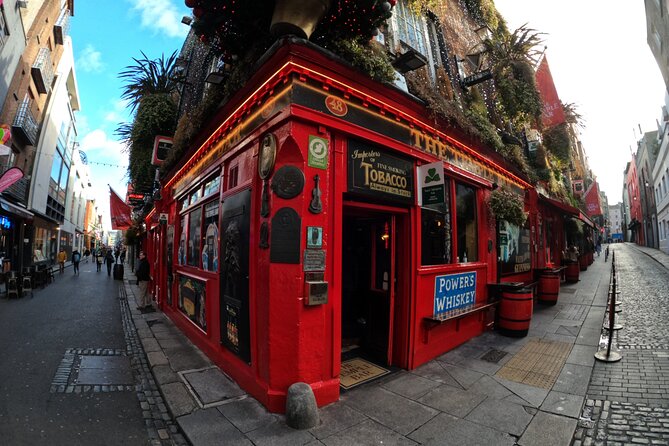
The Temple Bar Pub follows, with its history and the story of the Temple Bar district. The pub dates to 1840, and the surrounding area gives you the classic cobblestoned Dublin scene. This is one of the city’s most photographed quarters, but it is also one of the most tourist-focused. I like seeing it with a guide who can explain how the area became famous, rather than treating the pub as the whole of Dublin.
You do not receive a drink or pub admission as part of the stated inclusions. The value here is the setting, local context, and advice about where to eat or drink later.
Crossing the Liffey at Ha’penny Bridge
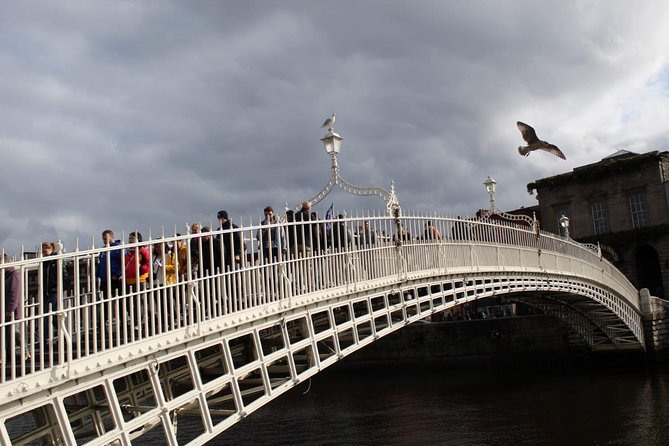
The walk continues to Ha’penny Bridge, one of Dublin’s best-known crossings. Your guide explains the bridge’s past and uses the River Liffey to discuss the city’s social and economic divisions.
That broader context makes this more than a photo stop. From the bridge, you can look along the river and see how central Dublin is arranged around movement, trade, neighborhoods, and public life. Allow about fifteen minutes here, including time for photographs.
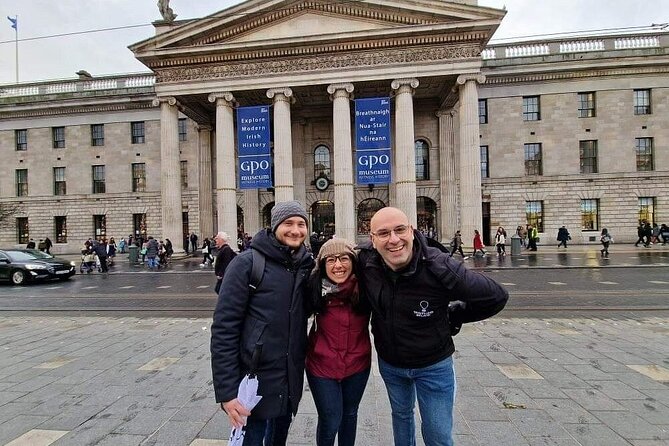
The route then reaches College Green, where the Bank of Ireland occupies the former Irish Parliament House. Trinity College sits to the east, with nineteenth-century buildings to the south. The three-sided plaza brings together Irish political history, architecture, education, and city traffic in one compact view.
This is a good place to ask questions. Ireland’s political story is not simple, and the tour later visits government and parliamentary buildings. A guide can help connect the old Parliament House with the modern institutions you see farther along the route.
Trinity College and the Molly Malone story
The tour enters the Trinity College campus for a fifteen-minute stroll. Trinity is Ireland’s oldest college, and the walk covers both its past and its role today.
The itinerary does not list admission to the Book of Kells or the Old Library. That is important when you compare this outing with a ticketed Trinity visit. You see the campus and hear its story, but you should plan a separate visit if the library and manuscript are priorities.
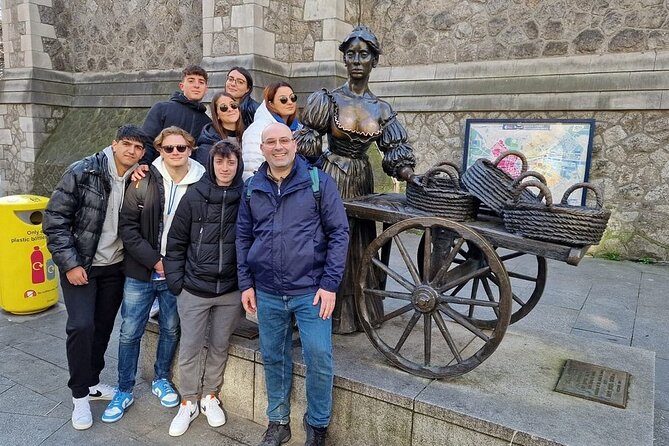
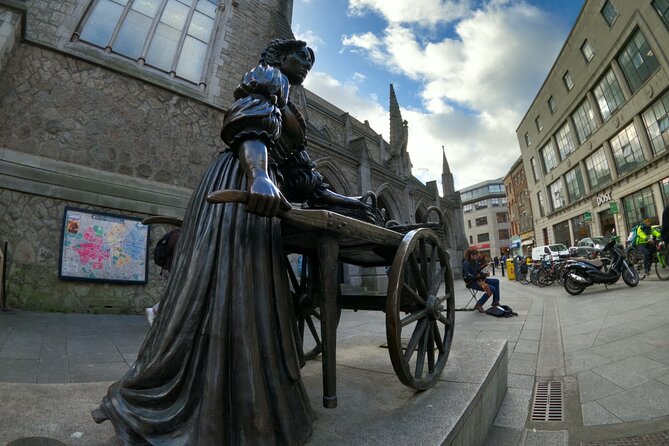
After Trinity comes the Molly Malone statue near St. Andrew’s Church. The stop brings in folklore and the famous song associated with the Dubliners. Molly Malone is one of those city symbols that can seem lighthearted at first, but it opens a conversation about Dublin’s songs, working life, and the way folklore shapes a city’s identity.
This is also a useful photo stop. The guide can explain what is known, what belongs to legend, and why the statue has become such a familiar meeting point.
More Walking Tours in Dublin
- Dublin Highlights and Hidden Gems Guided Walking Tour
★ 5.0 · 6,020 reviews - Dublin: Highlights and Hidden Gems Walking Tour
★ 4.9 · 2,140 reviews - 1916 Rebellion Walking Tour
★ 5.0 · 1,605 reviews - 90 Minute Dublin Walking tour and Sightseeing tips
★ 5.0 · 916 reviews
Grafton Street performers and St. Stephen’s Green
Grafton Street shifts the mood from history to present-day Dublin. It is a major shopping street, home to Brown Thomas and its luxury brands, but its street performers are the real reason the walk feels local and lively.
Musicians, poets, and other performers appear along the street, and your guide can point out how this public space functions beyond shopping. You will have about fifteen minutes here, enough to take in the atmosphere without turning the tour into a retail stop.
At the top of Grafton Street lies St. Stephen’s Green. The park gives you a welcome change from pavement and traffic. The walk includes its paths, greenery, swans, and ducks, with around fifteen minutes to look around.
The park is one of the tour’s gentler sections, especially for families and anyone who wants a pause. Still, do not mistake the stop for a long rest break. The route continues, and the full outing involves steady walking.
Famine memory and Wolfe Tone
The Edward Delaney Famine Memorial offers one of the most serious moments on the route. Its thin, struggling figures represent the hunger and hardship of the Great Famine, when many people suffered and died.
This stop matters because it puts human faces, or near-human forms, to an event that can otherwise be reduced to a paragraph in a history book. The sculptures are stark. Give yourself time to look rather than rushing through for a photograph.
The tour then reaches the statue of Theobald Wolfe Tone in front of the Shelbourne Hotel. Tone is widely regarded as the father of Irish republicanism. His statue connects the walk to the political movements that helped shape modern Ireland.
For some people, this will be the most useful part of the tour. The guide can explain how Irish politics developed across different periods, and Sharon has been praised for adding discussion of current Irish politics to the historical material. That kind of conversation is one of the strongest reasons to choose a private walk instead of following a fixed group script.
Government buildings and Georgian Dublin
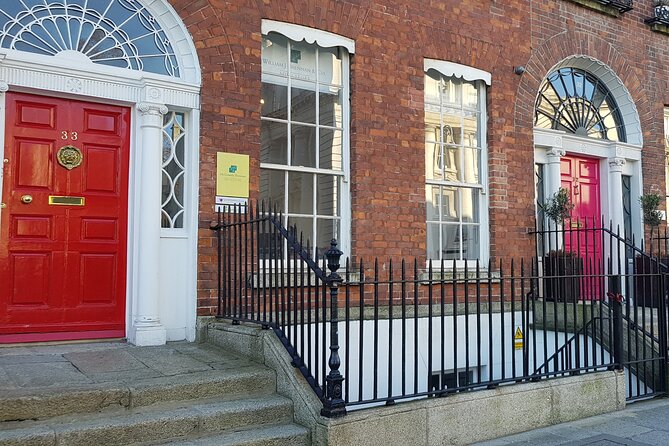
The Department of the Taoiseach introduces you to Ireland’s modern government. The surrounding Georgian district adds architecture and urban history, with orderly façades and broad streets that feel quite different from Temple Bar’s narrow lanes.
The visit is an exterior orientation rather than an entry into government offices. The same applies to Leinster House, the former ducal home of the Duke of Leinster and the parliament building of the Irish Free State since 1922.
These stops are short, about ten minutes each, but they give the route a useful political thread. You begin with the former Parliament House at College Green, then see the government department and national parliament. If you are curious about how Ireland is governed, say so early. A private guide has room to shape the explanation around your interests.
The Georgian section is also a good reminder that Dublin is not one visual style. Temple Bar, Trinity, the parks, government buildings, and Merrion Square each show a different side of the city.
Oscar Wilde and Merrion Square
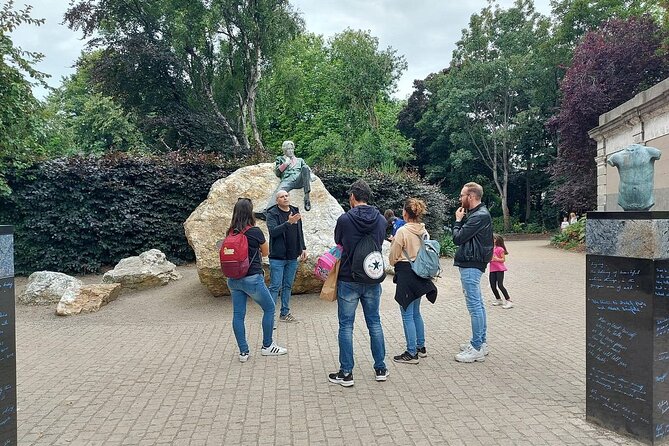
The final stop is the Monument to Oscar Wilde in Merrion Square Park. The statue sits near Wilde’s eighteenth-century home, and the park offers one of Dublin’s finest examples of Georgian urban design.
It is a fitting endpoint. The walk begins with Irish music and a traditional ring, then moves through folklore, politics, famine, public parks, and literature. Oscar Wilde brings the focus back to Dublin’s creative life.
The official end point is the Oscar Wilde Monument on Merrion Square North. That is useful for planning your next move, though no onward transportation is included. You may want to ask your guide for a nearby restaurant or pub suggestion before saying goodbye.
How much walking and history fit into three hours
The tour is listed at approximately three hours, with the individual stops generally lasting ten to fifteen minutes. The timing gives you a broad sweep rather than long visits inside attractions.
I would call the pace manageable for most people who are comfortable walking in a city. Good walking shoes are a must. Dublin weather can change quickly, and umbrellas are provided, but a light rain jacket is still sensible.
Families can take part, and rest or toilet breaks can be made if needed. The tour is described as family-friendly and suitable for all age groups. Very young children may find a full three-hour history walk tiring, though guides have worked to keep children engaged and can adjust the pace.
The route is near public transportation, and most people can participate. Service animals are allowed. Because the experience is private, you can discuss your group’s needs with the guide rather than trying to keep up with a large party.
What the $163.26 price buys you
At $163.26 per person, this is not the cheapest way to see Dublin. The price includes an experienced licensed guide, a private tour for your group, umbrellas, local suggestions, photo stops, and flexibility in pacing.
The important question is group size. For one or two people, the cost is a major splurge. For a family or group that would otherwise pay several separate admission fees and book multiple activities, the private format may be easier to justify. Group discounts are available, though the exact savings depend on the booking.
You are paying for interpretation and attention, not attraction tickets. The route includes many free public sights, and the tour does not replace separate visits to places that charge admission. I see this as a strong introduction to Dublin, especially if you want help deciding how to use the rest of your time.
The tour is booked, on average, about 55 days ahead. That suggests you should reserve early if your dates are fixed, particularly during popular periods. Departure times vary, which helps you fit the walk around flights, meals, or other plans.
The guide makes the difference
The strongest feature is the human one. Pasquale is repeatedly praised for warmth, humor, historical skill, and an unhurried manner. He has tailored walks to families, music fans, and people interested in Irish politics. One unusual moment involved an unexpected stop to see a swan, a small example of how a private route can respond to what is happening around you.
Conor has been praised for clear communication before the walk, photographs at each stop, and a video memory with music and map points afterward. Sharon has added current political detail, while Seamus has been described as respectful, friendly, and able to shape the walk around a group’s interests.
You cannot guarantee a specific guide unless the operator confirms it. If Pasquale or Conor matters to you, ask when booking. The guide’s personality will shape the experience more than any individual statue.
Who should book this Dublin tour?
I would choose this walk if you are visiting Dublin for the first time and want a useful city overview before exploring alone. It also suits families, couples, older relatives who prefer a private pace, and repeat visitors who want more cultural or political context.
Music fans get Claddagh Records and the Wall of Fame. History-minded visitors get the former Parliament House, Trinity, the Famine Memorial, Wolfe Tone, government offices, and Leinster House. Literature fans get Oscar Wilde, while shoppers and people-watchers get Grafton Street.
I would hesitate if you want long indoor visits, museum entry, or a low-cost group tour. I would also think twice if three hours of city walking feels too demanding. The route is broad and satisfying, but its purpose is orientation and storytelling, not a series of extended attraction visits.
Should you book the Dublin Private Walking Tour?
Book it if you value a personal guide and want to understand Dublin before setting off on your own. The mix of famous sights and less obvious themes is well chosen, and the route gives you practical advice you can use for the rest of your stay.
The price is fair only when the private format matters to you. For a small group that wants flexibility, photos, restaurant tips, and an easy conversation about Irish history and current life, it can be money well spent. For a solo visitor on a tight budget, a cheaper shared walk may be better.
Schedule it early, wear comfortable shoes, carry a light rain jacket, and tell the guide what interests you. That is how you turn a standard city walk into a useful personal introduction to Dublin.
FAQ
How long is the Dublin Private Walking Tour?
The tour lasts approximately three hours.
How much does the tour cost?
The listed price is $163.26 per person. Group discounts are available.
Is this a private tour?
Yes. Only your group participates in the private activity.
What language is offered?
The tour is offered in English.
Where does the tour begin?
It begins at Travelling Ireland Viaggiare in Irlanda, 8 Cecilia Street, Temple Bar, Dublin, D02 RW82, Ireland.
Where does the tour end?
The tour ends at the Oscar Wilde Monument on Merrion Square North in Dublin.
Which Dublin sights are included?
The route includes Claddagh Records, the Wall of Fame, Temple Bar Pub, Ha’penny Bridge, College Green, Trinity College, the Molly Malone statue, Grafton Street, St. Stephen’s Green, the Edward Delaney Famine Memorial, the Wolfe Tone statue, the Department of the Taoiseach, Leinster House, and the Oscar Wilde Monument.
Are attraction admission tickets included?
The listed stops show free admission, and the tour includes public sights and campus areas. Separate admission tickets for paid attractions are not listed as included.
Is the tour suitable for families?
Yes. All age groups are catered for, and the experience is described as family-friendly. Rest and toilet breaks can be arranged if needed.
Are umbrellas provided?
Yes. Umbrellas are included, though a light rain jacket and good walking shoes are still sensible.
Can service animals take part?
Yes. Service animals are allowed.
Can I cancel for a full refund?
Yes, if you cancel at least 24 hours before the experience start time. Cancellations made less than 24 hours in advance are not refunded, and changes within that period are not accepted.
Just added around Dublin
- Women Of Ireland: Trailblazers & Pioneers★ 5.0 · 4 reviews
- Wicklow Mountains & Glendalough Luxury Private Day Tour★ 5.0 · 23 reviews
- Wicklow tour of Glendalough★ 4.5 · 8 reviews
- Full Day Private Wicklow Tour★ 5.0 · 12 reviews
- Premium Irish Whiskey Tasting Hosted by Local Dublin Expert★ 5.0 · 77 reviews
- Whiskey Tasting Tour of Dublin★ 5.0 · 117 reviews
- Dublin To Kilkenny Castle Waterford Crystal Private Car – Day Tour★ 5.0 · 8 reviews
- Historical Walking Tour of Dublin★ 5.0 · 50 reviews
Walking Tours, compared.
Dublin Highlights and Hidden Gems Guided Walking Tour
Read our review →

90 Minute Dublin Walking tour and Sightseeing tips
Read our review →

Historical 2-Hour Guided Walking Tour of Dublin
Read our review →
Dublin Traditional Irish 3 Course Meal Walking Tour with Local
Read our review →
Browse the lists this tour appears in