
Reviewed · WALKING TOURS
Private Walking Tour in Dublin
Dublin’s story comes into focus on foot, from the 1916 Easter Rising at the GPO to the Viking settlement beneath Wood Quay and the medieval churches around Christchurch. This private walking tour links the city’s major sights in about two to three hours, giving you a useful first look before exploring on your own.
I like the personal format and the broad sweep of the route. A guide can adjust the pace for your group, answer questions as they arise, and point out the places worth returning to later. I also like that the walk includes both famous sights and less obvious historical stops, such as Wood Quay’s Viking settlement.
The main consideration is cost: at $90.11 per person, this is not the cheapest way to see central Dublin, especially since admission to Trinity College’s Book of Kells display, Christ Church Cathedral, Saint Patrick’s Cathedral, and Dublin Castle is not included. You are paying for a private guide and a useful orientation, not a full day of indoor sightseeing.
Key points to know before booking
- A private route through Dublin’s central core: Only your group takes part, so the pace and questions can be more personal than on a large group walk.
- Eleven stops in two to three hours: The route covers Trinity College, the GPO, Temple Bar, Viking Dublin, both major cathedrals, Dublin Castle, and more.
- A strong first-day introduction: The walk begins at Trinity College and ends near the Molly Malone statue, making it easy to continue sightseeing afterward.
- History takes center stage: You’ll move from Viking settlement and medieval churches to British rule and the Easter Rising.
- Several admission fees are extra: The walk views some major buildings from outside, but entry tickets are not included at key stops.
- English-speaking guides with different strengths: Francesca, John, Sinead, and Yvonne are named guides connected with the experience, with particular praise for clear explanations, flexibility, and family-friendly pacing.
Why this private Dublin walk works as a first introduction
Dublin is compact enough to explore on foot, but its story can feel scattered at first. Georgian streets, medieval churches, Viking archaeology, literary figures, and modern Irish independence all overlap in a relatively small area. This walk gives you a framework for understanding how those pieces fit together.
You begin at Trinity College Dublin on College Green and finish at the Molly Malone statue on Suffolk Street. The route makes a broad arc through central Dublin, so you see the city’s main historic districts without spending time figuring out directions.
The private format matters here. If you want to stop for questions about Irish history, ask for restaurant suggestions, or slow down for children, your guide can respond to your group instead of keeping to a fixed crowd. Sinead is specifically described as tailoring the walk around what the group wanted, while John adjusted comfortably for children aged six and eight.
Guides named in the available information include Francesca, John, Sinead, and Yvonne. Francesca is praised for a friendly overview and practical recommendations for later activities. Yvonne is noted for explaining different periods of Irish history and why they mattered to Dublin. The individual guide will affect the tone, but the route itself gives every guide plenty to work with.
More Private Tours in Dublin
- The Dublin Private Walking Tour
★ 5.0 · 701 reviews - Private Dublin Arrival Transfer – Airport to Hotel / Accommodation
★ 3.5 · 304 reviews - Private (Nearly!) All of Dublin in 5 hours (Walking Tour)
★ 5.0 · 281 reviews
Trinity College and the literary side of Dublin
The first stop is Trinity College, founded in 1592 under Queen Elizabeth I. It is Ireland’s oldest university and remains one of the country’s best-known academic institutions. The grounds give you an immediate sense of Dublin as a city shaped by learning, politics, religion, and literature.
The tour allows about 20 minutes here. That is enough for an introduction to the college and its famous graduates, including Oscar Wilde, Bram Stoker, and Jonathan Swift. It is not enough for a full visit to the Book of Kells exhibition or the Old Library.
Admission is not included. If seeing the Book of Kells and the Old Library is high on your list, plan a separate visit and check the current entry arrangements. The walking tour helps you understand why Trinity matters, but it should not be treated as a substitute for going inside.
Starting here is smart. College Green is central, easy to reach by public transport, and close to several of the city’s main sights. It also gives you a clear reference point for returning to the area later.
The GPO, the Spire, and modern central Dublin
The General Post Office is one of the most important stops on the walk. Its elegant Georgian exterior became closely tied to the 1916 Easter Rising, when Irish Volunteers and the Irish Citizen Army seized the building on Easter Monday. Bullet marks from the fighting can still be seen on the front pillars.
You spend about 15 minutes at the GPO. The building is a powerful place to discuss Irish independence because the story is connected to an ordinary civic building rather than an isolated monument. The GPO Museum is inside, but admission is not included. If you want exhibits and more detailed interpretation, you’ll need a separate ticket.
A short distance away, the Spire rises 120 meters above O’Connell Street. Officially called the Monument of Light, it was built as a modern millennium project and is free to view. Its narrow steel form is hard to miss, and it offers a useful change of mood after the GPO’s political history.
The Spire stop lasts about five minutes. That is enough to look up, hear the basic story, and take a photograph. You should not expect a lengthy discussion of modern art or an extended visit.
Crossing the Liffey at Ha’penny Bridge
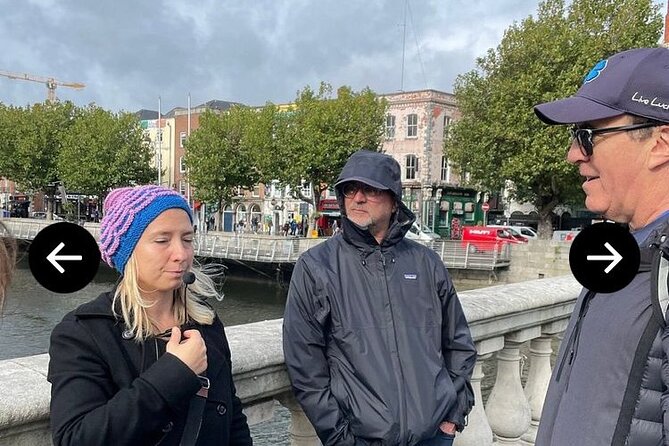
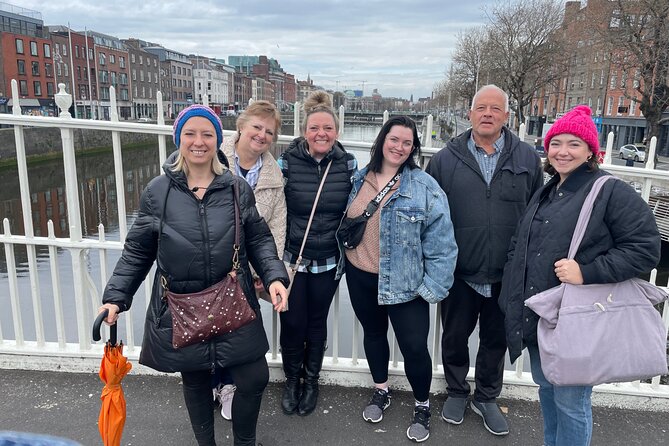
The Ha’penny Bridge is officially the Liffey Bridge and was built in 1816. It was Dublin’s first pedestrian bridge, and its familiar name came from the half-penny toll once charged to cross it.
This is another short stop, about five minutes, but it helps you understand Dublin’s geography. The River Liffey divides the north and south sides of the city, and the bridge connects two areas that visitors often explore separately.
The bridge is free to see, and you’ll likely have time for a quick photo and a look along the river. Since the tour includes many historic sites, these short visual pauses keep the pace moving. If you prefer extended photography time, tell your guide early so you can see how the schedule can be adjusted.
More Walking Tours in Dublin
- Dublin Highlights and Hidden Gems Guided Walking Tour
★ 5.0 · 6,020 reviews - Dublin: Highlights and Hidden Gems Walking Tour
★ 4.9 · 2,140 reviews - 1916 Rebellion Walking Tour
★ 5.0 · 1,605 reviews - 90 Minute Dublin Walking tour and Sightseeing tips
★ 5.0 · 916 reviews
Temple Bar beyond the pub signs
Temple Bar is Dublin’s best-known nightlife and cultural quarter. The area is associated with traditional Irish music, pubs, restaurants, and narrow streets that attract a steady stream of visitors.
The planned stop lasts about 15 minutes. The useful part is not simply seeing the famous pub fronts. Your guide can place the district within Dublin’s older neighborhoods and point out where to return if you want food or music later.
Temple Bar can be crowded and commercial, so expectations matter. This walk gives you an orientation, not a full evening of entertainment. You are not guaranteed a music performance during the tour, and the stop is too brief to sample several restaurants. I would treat it as a chance to learn where the district is and then decide later if it fits your evening plans.
Wood Quay and Dublin’s Viking beginnings
Wood Quay adds an important layer to the route. Archaeological work near the area uncovered one of the largest Viking settlements outside Scandinavia. Vikings settled in Dublin in 841 AD, first arriving as raiders and traders before establishing a permanent presence.
The stop lasts about 15 minutes and helps correct the idea that Dublin began as a purely medieval or Georgian city. The city’s roots reach back to a settlement shaped by movement, trade, conflict, and permanent occupation.
This is one of the more valuable stops for people who enjoy archaeology but might not visit a dedicated museum. You see the modern city while learning that the ground beneath it holds evidence of a much older settlement. The tour does not include a museum admission here, so the value comes from the guide’s explanation and the setting.
Christ Church Cathedral and medieval Dublin
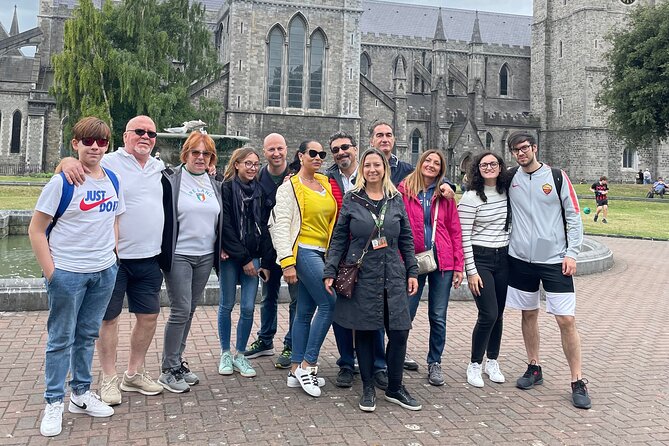
Christ Church Cathedral sits in the medieval district and has welcomed pilgrims and visitors for nearly 1,000 years. It began as a Viking church and later became one of Dublin’s most important religious buildings.
The scheduled visit is about 15 minutes, with admission not included. From the outside, you can discuss the cathedral’s place in the old city. If you want to see the interior, including Strongbow’s tomb and a copy of the Magna Carta, plan to pay separately.
Christ Church is a good place to ask your guide about the transition from Viking Dublin to medieval Christian Dublin. The two parts of the story are close together geographically, and the route makes that connection easy to grasp.
A 15-minute stop is a limit, not a promise of a full cathedral visit. If the interior is a priority, ask how much time your guide can allow or return on your own. The private setup may give you some flexibility, but the total walk still needs to fit within two to three hours.
Saint Patrick’s Cathedral and the Liberties
Saint Patrick’s Cathedral is in the Liberties, one of Dublin’s historic districts. The present building was completed between 1225 and 1270 in honor of Ireland’s patron saint. Tradition connects the site with the baptism of Irish Gaelic people by Saint Patrick.
The cathedral is also linked with Jonathan Swift, whose tomb is inside, along with other historic objects. Admission is not included, and the planned stop is about 15 minutes.
This stop works best for visitors who want the religious and literary strands of Dublin’s story together. You get a sense of the cathedral’s age and importance, but you should budget extra time and money if you want to explore the building properly.
The route includes both Christ Church and Saint Patrick’s. That is useful because the two cathedrals are often confused by first-time visitors. Seeing them in the same walk makes their different settings and roles easier to remember.
Dublin Castle and seven centuries of rule
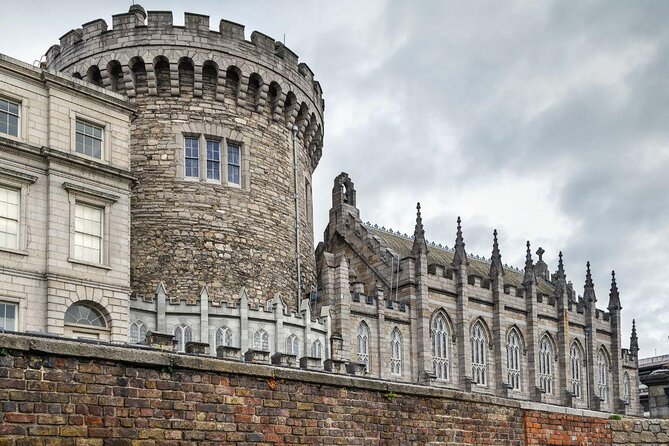
Dublin Castle was the seat of the viceroy, the representative of the English monarch in Ireland, for more than 700 years. The Record Tower is the only surviving part of the original medieval castle. Much of what you see today consists of State Apartments built in the 18th century.
The tour allows about 20 minutes here, and admission is not included. The exterior and surrounding grounds provide a clear introduction to the castle’s political role, but a proper interior visit requires a separate ticket.
For many people, this is the point where the city’s political story becomes tangible. After hearing about the Easter Rising at the GPO, you see the former center of English administration in Ireland. The walk does not turn the subject into a long lecture, but it gives you the basic sequence: medieval power, later British administration, and the struggle for Irish independence.
If you want to visit the State Apartments, ask your guide how to fit that into the rest of your day. The castle stop itself is short, and the attraction’s interior deserves more time than the walking schedule provides.
George’s Street Arcade and Dublin’s everyday character
George’s Street Arcade is Dublin’s oldest shopping center and one of the city’s clearest examples of Victorian-era architecture. It has operated for almost 140 years as part of the South City Market buildings, with shops and stalls inside.
The stop is only about five minutes, but it adds a more ordinary, local-feeling note to a route filled with grand institutions and national landmarks. You can see how shopping and small businesses fit into the historic center.
Do not expect time for a long browse. The arcade is best treated as a place to mark for a return visit. If you enjoy markets, independent shops, or Victorian architecture, this may be one of the stops you’ll want to revisit after the guide moves on.
Molly Malone and the walk’s final image
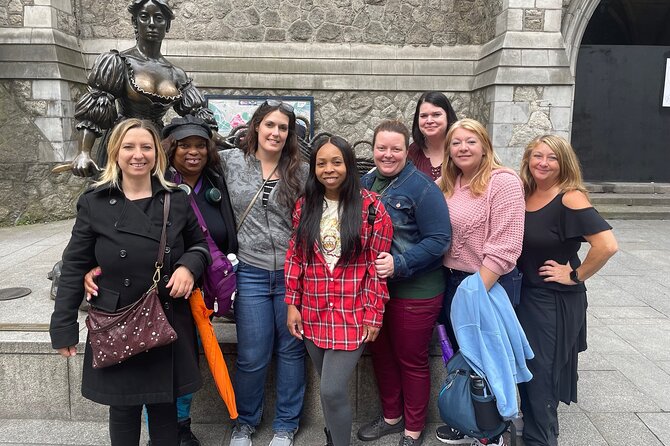
The tour ends at the Molly Malone statue on Suffolk Street. The statue was unveiled in 1988 for Dublin’s first millennium celebration and represents the character from the well-known song that has become an unofficial Dublin anthem.
The story behind Molly Malone remains uncertain. One theory connects her with a real woman who died in Dublin in 1699, but the statue is best understood as a popular symbol rather than a firmly documented historical figure.
Ending here is practical. The statue is in central Dublin, and you can continue toward nearby sights, shops, or restaurants after saying goodbye to your guide. It also gives the walk a lighter final note after the political and religious history earlier in the route.
What the $90.11 price really buys you
At $90.11 per person, the tour makes the most sense for a small group that values private attention. You are paying for a guide who can set the pace, answer your own questions, and tailor the experience rather than for a bundle of admission tickets.
The price is harder to justify if you mainly want entrance to Dublin’s interiors. Tickets for Trinity College attractions, the GPO Museum, Christ Church Cathedral, Saint Patrick’s Cathedral, and Dublin Castle are not included. Add those separately and the total cost rises.
I see the best value in booking this early in your Dublin stay. The route gives you a mental map of central Dublin and helps you decide which places deserve a longer visit. Francesca is noted for offering suggestions about things to do later, which is exactly the kind of practical help that makes a first-day walk useful.
The tour is also a sensible choice for families. John is specifically described as accommodating children aged six and eight, though every group’s pace is different. Most people can participate, and service animals are allowed. The tour operates near public transportation, but no hotel pickup is provided in the supplied details, so you should reach Trinity College independently.
The experience is offered in English. It is commonly booked well ahead, with an average booking lead time of 49 days, so last-minute availability may be limited. Confirmation is normally provided at booking, subject to availability for bookings made within 12 hours of departure.
Free cancellation is available up to 24 hours before the start time. Changes or cancellations inside that window are not refunded, and poor weather can lead to a new date or a full refund. Since this is an outdoor walk, Dublin’s weather is a real planning factor.
Who should book this Dublin walking tour
I would choose this walk for a first visit, especially if you have only a day or two to get your bearings. It connects the city’s main historic themes without requiring you to plan a route through unfamiliar streets.
It also suits families and groups with mixed interests. One person can ask about literary Dublin, another about the Easter Rising, and another about medieval churches. The private setup is useful when those questions would slow down a regular group tour.
You may want something else if you prefer long interior visits, museum time, or a slow photography walk. Eleven stops in two to three hours means the pace is purposeful. Several stops last only five minutes, and the main attractions charge admission separately.
Should you book it?
Book this private Dublin walk if you want a clear historical introduction, personal guide attention, and a sensible route through the city center. It is especially good as an opening activity, before you return to Trinity College, the cathedrals, the GPO Museum, or Dublin Castle on your own.
Skip it if $90.11 per person feels high for an outdoor overview or if you already know Dublin well. The tour is strongest as a starting point, not as a replacement for the city’s major indoor attractions.
FAQ
How long does the private walking tour last?
The tour lasts approximately two to three hours.
Where does the tour begin?
It begins at Trinity College Dublin, College Green, Dublin 2, Ireland.
Where does the tour end?
The tour ends in front of the Molly Malone statue on Suffolk Street, Dublin 2.
Is this a private tour?
Yes. Only your group participates in the private activity.
What language is the tour offered in?
The tour is offered in English.
Are admission tickets included?
Admission is not included for Trinity College, the GPO Museum, Christ Church Cathedral, Saint Patrick’s Cathedral, or Dublin Castle. The Spire, Ha’penny Bridge, Temple Bar, Wood Quay Amphitheatre, George’s Street Arcade, and Molly Malone statue are listed with free admission.
What does the tour cost?
The listed price is $90.11 per person.
Can children join the tour?
Most people can participate, and the tour has accommodated children aged six and eight. The information provided does not list a specific minimum age.
Can I cancel for a full refund?
You can cancel up to 24 hours before the experience start time for a full refund. If poor weather causes the tour to be canceled, you’ll be offered another date or a full refund.
Just added around Dublin
- Women Of Ireland: Trailblazers & Pioneers★ 5.0 · 4 reviews
- Full Day Private Wicklow Tour★ 5.0 · 12 reviews
- Wicklow Mountains & Glendalough Luxury Private Day Tour★ 5.0 · 23 reviews
- Wicklow tour of Glendalough★ 4.5 · 8 reviews
- Premium Irish Whiskey Tasting Hosted by Local Dublin Expert★ 5.0 · 77 reviews
- Whiskey Tasting Tour of Dublin★ 5.0 · 117 reviews
- Dublin To Kilkenny Castle Waterford Crystal Private Car – Day Tour★ 5.0 · 8 reviews
- Historical Walking Tour of Dublin★ 5.0 · 50 reviews
Walking Tours, compared.
Dublin Highlights and Hidden Gems Guided Walking Tour
Read our review →

90 Minute Dublin Walking tour and Sightseeing tips
Read our review →

Historical 2-Hour Guided Walking Tour of Dublin
Read our review →
Dublin Traditional Irish 3 Course Meal Walking Tour with Local
Read our review →
Browse the lists this tour appears in